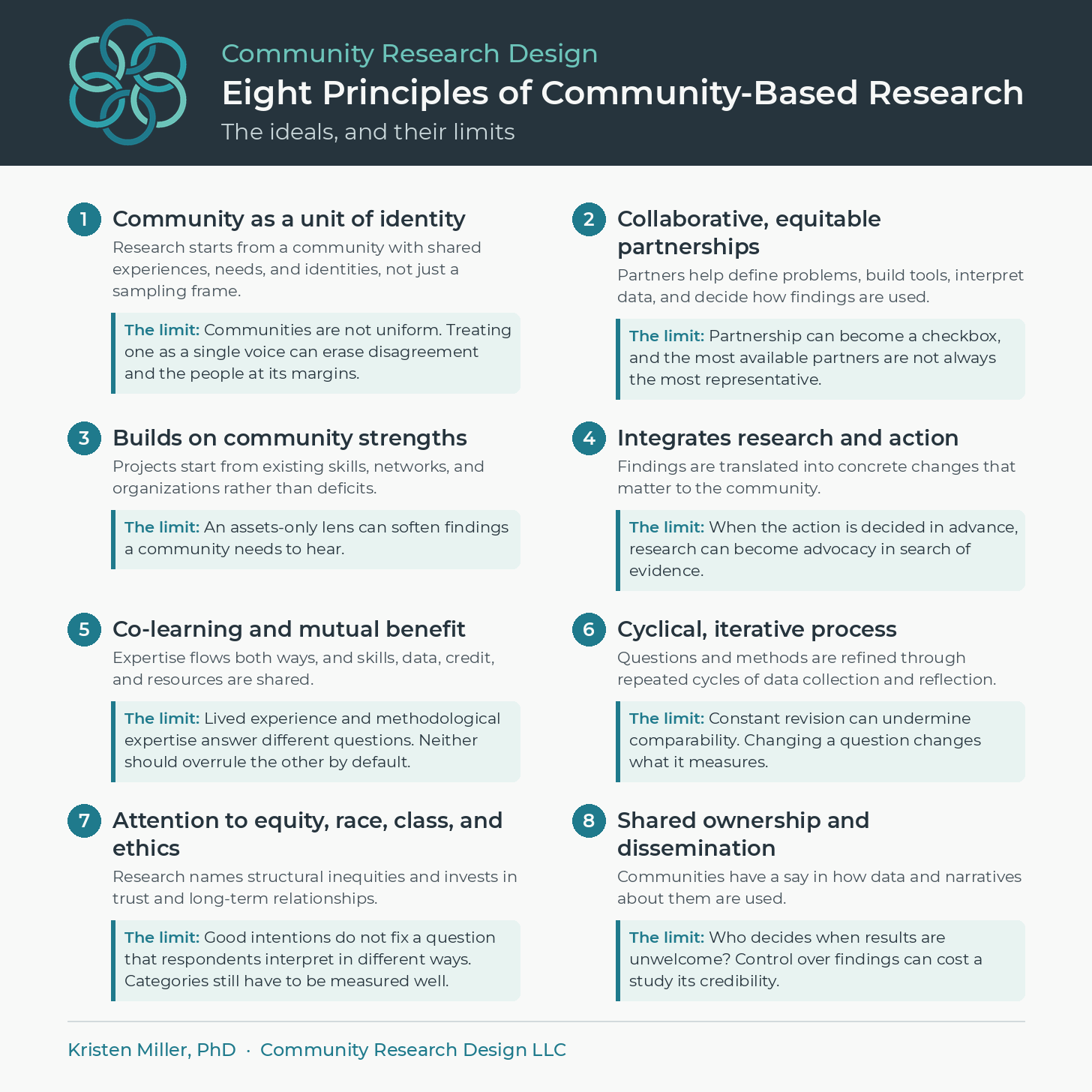
“Community-based research” has become a phrase that signals good intentions more than it describes a method. It can mean a community genuinely shaped a study. It can also mean a few listening sessions were held, a community advisory board signed off, and the research went on as planned.
The principles below come from the community-based participatory research tradition. I think they’re worth taking seriously, but they are not self-executing, and they come with real problems. Who speaks for a community? Whose lived experience counts when community members disagree? What happens when partnership becomes a reason to skip the hard work of testing whether questions actually measure what we think they measure?
My interest is in the methods underneath the ideals: how to make community involvement improve the quality of the data rather than just the optics of the project. I’ll be writing about where these principles hold up, where they break down, and what rigor looks like when communities are part of the work.